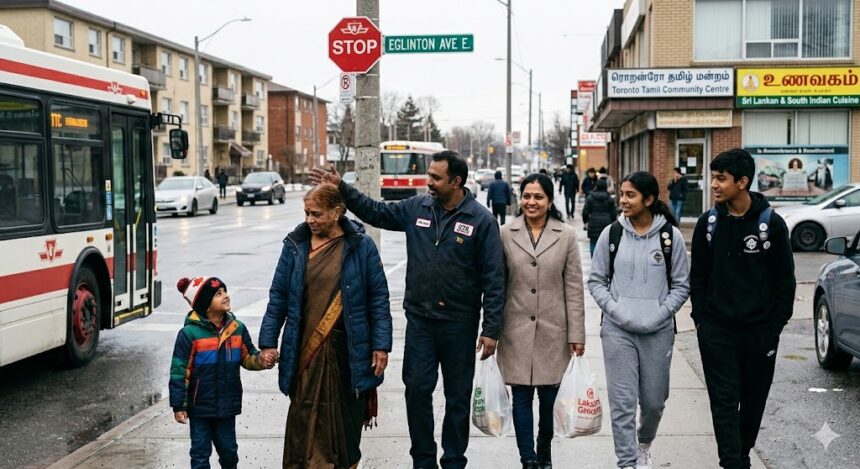
An Analysis of Human Rights Implications for Tamil Refugees from Sri Lanka and India by Dr. AMM. Fahath.
Introduction
Canada has long been regarded as one of the most welcoming nations for refugees and asylum seekers. Its robust legal framework, grounded in the 1951 Refugee Convention, has provided protection to hundreds of thousands of people fleeing persecution, war, and human rights violations. However, the introduction of Bill C-12 — officially known as the Strengthening Canada’s Immigration System and Borders Act — threatens to fundamentally alter this humanitarian legacy. Introduced in October 2025 and passed by the House of Commons in December 2025, Bill C-12 now awaits Senate approval. If enacted into law, it will impose sweeping restrictions on the right to seek asylum, with devastating consequences for vulnerable populations — most notably Tamil refugees fleeing persecution in Sri Lanka and India.
What is Bill C-12?
Bill C-12 is a 326-page omnibus legislation that fundamentally restructures Canada’s refugee determination system. Its most alarming provisions include a “one-year ineligibility rule,” which bars any person who has been present in Canada for more than 12 months from having their asylum claim referred to the Immigration and Refugee Board (IRB). Additionally, a “14-day rule” disqualifies refugee claims made at land border crossings from the United States if filed more than 14 days after arrival. The bill also grants the federal government sweeping powers to cancel immigration documents, including permanent residence applications and work or study permits, on vague “public interest” grounds — without individualized assessment or due process.
Those rendered ineligible under these new rules are redirected to a Pre-Removal Risk Assessment (PRRA) process — a mechanism that has historically rejected approximately 80 percent of applicants. Unlike IRB hearings, the PRRA process lacks independent decision-makers, does not guarantee oral hearings, offers no meaningful right of appeal, and does not automatically stay deportation while decisions are being challenged. Critics, including Amnesty International, the Canadian Civil Liberties Association (CCLA), and the UN High Commissioner for Refugees (UNHCR), have warned that Bill C-12 falls below minimum international human rights standards and risks violating Canada’s obligations under the 1951 Refugee Convention and the principle of non-refoulement.
Human Rights Violations: A Legal and Moral Crisis
The principle of non-refoulement — the cornerstone of international refugee law — prohibits states from returning individuals to countries where they face persecution, torture, or other serious harm. Bill C-12 directly undermines this principle by denying thousands of genuine refugees a fair and independent hearing. By replacing full IRB hearings with a curtailed PRRA process, the bill increases the probability of erroneous deportations to countries of danger.
The CCLA has explicitly warned that Bill C-12 violates the Canadian Charter of Rights and Freedoms, which guarantees the right to life, liberty, and security of the person under Section 7. Denying refugees access to an independent, fair hearing — particularly when deportation to a country of persecution is the consequence — constitutes a fundamental breach of constitutional rights. The UNHCR has also testified before parliamentary committees that the one-year deadline is arbitrary, incompatible with the lived realities of refugees, and inconsistent with international law.
Many genuine refugees do not claim asylum immediately upon arrival. Survivors of trauma, torture, or state persecution often require months — sometimes years — before they feel safe enough to disclose their experiences or understand the legal process available to them. Domestic violence survivors, LGBTQ+ individuals, and those persecuted by state actors may fear that identifying themselves will trigger further harm. The rigid one-year deadline is entirely blind to these psychological realities.
Impact on Tamil Refugees from Sri Lanka
Tamil refugees from Sri Lanka represent one of the most historically significant refugee communities in Canada. Decades of ethnic conflict, the brutal civil war that ended in 2009, and continued post-war human rights abuses have driven tens of thousands of Tamils to seek protection abroad. Canada is home to one of the largest Tamil diaspora communities in the world, with an estimated 300,000 Tamils living primarily in the Greater Toronto Area.
Sri Lanka continues to be flagged by human rights organizations for systematic abuses against Tamils, including arbitrary detention, enforced disappearances, torture, and surveillance. Many Sri Lankan Tamils arrive in Canada through circuitous and harrowing journeys, often spending months or years in transit countries — sometimes legally, sometimes not. They may arrive in Canada on student visas, visitor visas, or work permits, not immediately identifying themselves as refugees due to fear, trauma, or lack of knowledge about the asylum process.
Under Bill C-12’s one-year rule, a Tamil student who arrives on a study permit in 2024 and only learns in 2026 — through contact with community members or a lawyer — that she qualifies for refugee protection would be barred from a full IRB hearing. Her claim would be directed to the PRRA process, where an 80 percent rejection rate effectively sentences her to deportation back to a country where she could face persecution, detention, or worse. The retroactive application of this rule — applying to all arrivals since June 2020 — is particularly alarming, as it could affect thousands of Sri Lankan Tamils currently in Canada who have not yet filed claims.
Furthermore, the sweeping ministerial powers to cancel immigration documents without individualized assessment place Tamil families who are in the process of applying for permanent residence at severe risk. Years of legitimate settlement and contribution to Canadian society could be erased overnight based on vague political determinations of “public interest.”
Impact on Tamil Refugees from India
While less frequently discussed than Sri Lankan Tamils, a significant number of Tamil asylum seekers in Canada originate from the Indian state of Tamil Nadu and the union territory of Puducherry. These individuals often flee politically motivated persecution, caste-based violence, threats from extremist groups, or state repression linked to their activism or political associations. India, despite being a democracy, is not a signatory to the 1951 Refugee Convention, and its domestic legal system offers limited formal protection to those fleeing internal persecution.
Indian Tamils often arrive in Canada through legitimate immigration pathways — as temporary workers, students, or visitors — before circumstances back home deteriorate and they are compelled to seek asylum. The one-year deadline under Bill C-12 would disproportionately harm this group, as they frequently delay their claims due to a complex combination of hope that the situation back home will improve, fear of family consequences, and limited access to legal information in their native language.
Caste-based violence and political persecution are rarely immediate, visible threats — they are often slow-building, escalating pressures that do not immediately trigger a sense of urgency in the victim. By the time a Tamil from India realizes that Canada’s protection system is their only viable option, a year may have already passed. Under Bill C-12, this person would be denied a fair hearing and fast-tracked toward deportation to a country that offers no formal refugee protection mechanism of its own.
Broader Implications: Systemic Discrimination and Marginalization
Critics have noted that the provisions of Bill C-12, while facially neutral, will have a disproportionate impact on racialized communities — including Tamil, South Asian, African, and Caribbean asylum seekers. The rushed legislative process — only six weeks of committee study for a 326-page bill — has meant that the voices of those most affected have been largely ignored. Advocacy organizations representing Tamil and other racialized refugee communities have not been meaningfully consulted.
The bill’s expanded information-sharing provisions also raise serious privacy concerns. Personal immigration data may now be shared broadly across federal, provincial, and territorial agencies without adequate safeguards — creating further risks of surveillance and profiling for vulnerable Tamil communities who have already experienced state persecution in their countries of origin.
Conclusion: Canada at a Crossroads
Canada stands at a critical crossroads. Bill C-12 represents the most significant rollback of refugee rights in decades — a rushed, politically motivated legislation that prioritizes border optics over human lives. For Tamil refugees from Sri Lanka and India, the consequences could be catastrophic: deportation to countries of persecution, separation from families, and in some cases, imprisonment, torture, or death.
The Canadian Senate must exercise its constitutional role as a chamber of sober second thought and reject Bill C-12 in its current form. Canada’s international reputation as a defender of human rights and a safe haven for the persecuted depends on it. To abandon Tamil and other refugee communities at this moment — when global displacement is at historic highs — would be a profound moral failure that betrays the very values Canada claims to stand for.
As Amnesty International has urged: Canada must choose a different path. It must uphold its international human rights obligations, protect those seeking refuge, and withdraw or fundamentally amend Bill C-12 before it becomes the law that dismantles a generation of hard-won humanitarian progress.